
A memorandum of understanding (MOU) is a written document produced at the end of a mediation session that records the terms both parties have agreed to — including property division, parental rights, support obligations, and any other resolved issues.
A memorandum of understanding (MOU) is not a court order and is not independently enforceable until one of the parties’ attorneys prepares a Final Settlement Agreement. Which ideally, both parties’ attorney have reviewed. The Final Settlement Agreement can become the basis for the final divorce decree. The goal of the mediation is to arrive at a memorandum of understanding that an attorney can draft into a proposed final agreement–that will ultimately be acceptable to a Maine District Court judge or magistrate.
Joy Crafts McNaughton, J.D., a licensed Maine attorney with 34 years of litigation experience and 181+ court-connected mediations, drafts memoranda of understanding for every private mediation session.
Key Takeaways
- A memorandum of understanding records the specific terms both parties agreed to during mediation — parental rights schedules, property division, support amounts, spousal support, and any other resolved issues.
- A memorandum of understanding is not a court order and does not become enforceable until one parties’ attorney drafts a Final Settlement Agreement for review for the Court–which can become incorporated into the Court’s final decree.
- Maine Revised Statutes Title 19-A §251(3) (court-ordered mediations) requires that mediated agreements be reduced to writing, signed by the parties, and presented to the court for approval as a court order.
- Private mediation allows parties to reach a memorandum of understanding before filing any court action, so the divorce or family matter can proceed as uncontested from the start.
Contested hearings cost both sides months and thousands in legal fees. A memorandum of understanding drafted during mediation with McNaughton provides both parties with a written framework that their attorneys can formalize. Call (207) 712-8995.
McNaughton always encourages parties to avail themselves of consult of legal counsel during mediation, before signing a MOU, and before signing the final settlement agreement. She does not supply legal advice.
How Does a Memorandum of Understanding Differ from a Court Order?
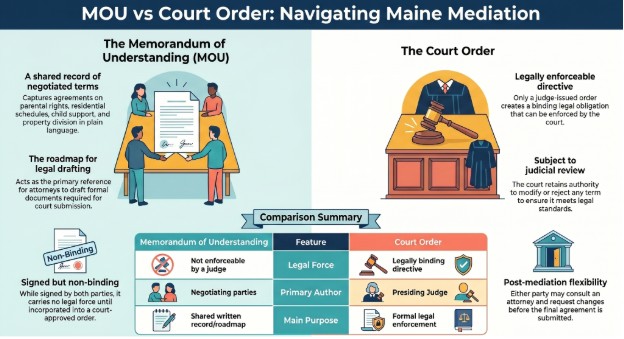
A memorandum of understanding records what the parties agreed to during mediation, while a court order is a legally enforceable directive issued by a judge, and the two documents serve fundamentally different purposes in the Maine legal process.
What a Memorandum of Understanding Does
A memorandum of understanding captures the negotiated terms in plain language so both parties leave the mediation session with a shared written record of every agreement reached:
- The document names each resolved issue — parental rights and responsibilities, residential schedule, child support amount, property division, alimony, and any other terms the parties addressed
- Both parties review and sign the memorandum of understanding at the conclusion of the session
- The document serves as a roadmap for each party’s attorney to draft the formal legal documents required for court submission.
What a Memorandum of Understanding Does Not Do
A memorandum of understanding drafted during mediation does not carry the force of a court order. The document cannot be enforced by a judge until the terms are incorporated into a formal agreement and approved by the court:
- A memorandum of understanding does not bind either party to a legal obligation until the court enters the agreement–drafted by one parties’ attorney and ideally reviewed by the other parties’ attorney– as an order
- The court retains authority to modify or reject any term of the Legal Settlement Agreement that does not meet legal standards — particularly terms involving child support, parental rights, and property division under Maine Revised Statutes Title 19-A §953
- Either party may consult an attorney after mediation and request changes to the terms of the MOU before the formal agreement is drafted and submitted to the court.
What Happens After the Mediator Drafts the Memorandum of Understanding?
The memorandum of understanding moves through three stages after the mediation session ends — attorney review, formal drafting of Marital Settlement Agreement– and court approval — so the agreement the parties negotiated becomes a legally enforceable court order.
Attorney Review
Each party takes the memorandum of understanding to an independent attorney for review. The mediator does not represent either party and does not provide legal advice during the session. Ideally, both parties have consulting attorneys during mediation–especially in complex cases.
Each party’s attorney evaluates the terms, identifies any provisions that may not serve the client’s interests, and advises the client on whether to accept, modify, or renegotiate specific terms before formal documents are drafted.
Attorney review protects both parties by ensuring that the mediated terms comply with Maine law and that neither party agreed to terms under pressure, misunderstanding, or incomplete information.
Maine Revised Statutes Title 19-A §251(4) requires that both parties make a good faith effort during mediation, but good faith in the mediation room does not replace independent legal counsel before signing a binding agreement.
Formal Drafting
One or both attorneys convert the memorandum of understanding into the formal legal documents required by the Maine courts — typically a comprehensive settlement agreement, a parenting plan, or both.
The formal documents translate the plain-language terms of the memorandum of understanding into language that meets court-filing requirements and statutory standards under the Maine Revised Statutes, Title 19-A.
Court Approval
Maine Revised Statutes Title 19-A §251(3) requires that mediated agreements “be reduced to writing, signed by the parties and presented to the court for approval as a court order.” The Maine Judicial Branch family court process confirms that when both parties resolve all issues through mediation, the court holds an uncontested final hearing to put the agreement on the record and ensure both parties understand the final order.
The court reviews the formal agreement for compliance with Maine law, including child support guidelines, parental rights standards, and equitable property division under Title 19-A § 953.
The judge may approve the agreement as submitted, request modifications, or schedule a hearing on specific provisions that raise concerns.
When Should Parties Use a Memorandum of Understanding in Maine?
Parties benefit from a memorandum of understanding at three stages of a Maine family law dispute — before filing, during pending litigation, and after a failed court-connected mediation conference.
Before Filing Any Court Action
Couples who engage a private mediator before filing a divorce petition in Maine can negotiate all contested issues and produce a memorandum of understanding that each party’s attorney reviews and converts into formal documents.
The divorce then proceeds as uncontested from the initial filing — avoiding the cost and delay of discovery, depositions, and contested hearings.
During Pending Litigation
Parties with a case already filed in the Maine District Court or Superior Court can use private mediation to negotiate a memorandum of understanding on some or all disputed issues.
Under Maine Rule of Civil Procedure 16B, parties in Superior Court civil cases must participate in alternative dispute resolution before trial.
A memorandum of understanding reached during private mediation satisfies the court’s alternative dispute resolution requirement and narrows the issues for any remaining contested hearing.
After a Failed Court-Connected Mediation
Parties who do not reach an agreement during a Court Alternative Dispute Resolution Service mediation conference can engage a private mediator for additional sessions.
Private mediation provides more time, more flexibility, and a mediator chosen by the parties, and a memorandum of understanding reached in private mediation carries the same weight as one reached through the court program.
How Does the Mediator Approach Drafting the Memorandum of Understanding?
McNaughton drafts the memorandum of understanding during or immediately following the mediation session, while both parties are present and the agreed-upon terms are clear.
The drafting approach reflects 34 years of Maine litigation experience and an understanding of what attorneys and judges need to see in the document before the terms can be formalized.
The memorandum of understanding includes the specific terms of each resolved issue in plain language, identifies any unresolved issues that require further negotiation or court determination, and outlines the next steps each party must take — including attorney review, document preparation, and court-filing deadlines.
McNaughton’s mediation background — including 15 jury trials, more than 500 workers’ compensation testimonial hearings, and 181+ court-connected family mediations — means the memorandum of understanding is drafted with litigation awareness.
The document anticipates the questions each party’s attorney will ask and addresses the provisions the court will review during the approval hearing. In complex cases, it is ideal for both parties to have at least consulting attorneys during the mediation process.
A memorandum of understanding turns a mediation session into a written framework that moves both parties toward resolution. McNaughton’s 181+ mediations and 34 years of Maine litigation experience ensure the document holds up under attorney review and court scrutiny. Call (207) 712-8995 to schedule.
Frequently Asked Questions
What is a memorandum of understanding in mediation?
A memorandum of understanding is a written document produced during or after a mediation session that records the specific terms to which both parties agreed. The document covers parental rights, property division, support obligations, and any other resolved issues — but is not enforceable until the court approves it.
Is a memorandum of understanding legally binding in Maine?
A memorandum of understanding from mediation is not independently legally binding in Maine. Maine Revised Statutes Title 19-A §251(3) requires that mediated agreements be reduced to writing, signed by the parties, and presented to the court for approval before the terms become an enforceable court order.
Do I need a lawyer to review the memorandum of understanding?
Each party should have an independent attorney review the memorandum of understanding before formal documents are drafted and filed with the court. The mediator does not represent either party and does not provide legal advice — independent counsel protects each party’s interests.
What happens if the court rejects part of the final settlement agreement (drafted by an attorney).
The court reviews the formal agreement for compliance with Maine law, including child support guidelines, parental rights standards, and equitable property division under Title 19-A §953. The judge may approve the agreement, request modifications to specific terms, or schedule a hearing on provisions that raise concerns.
Can a memorandum of understanding be used before filing for divorce in Maine?
Parties can reach a memorandum of understanding through private mediation before filing any court action. The memorandum of understanding serves as the basis for formal documents that attorneys draft and file with the divorce petition, allowing the case to proceed as uncontested from the start.
How long does it take to draft a memorandum of understanding?
The mediator typically drafts the memorandum of understanding during or immediately following the mediation session. Most family mediation sessions run two to three hours. Complex cases involve additional time for drafting.
What is the difference between a memorandum of understanding and a marital settlement agreement?
A memorandum of understanding records mediated terms in plain language and serves as a roadmap for formal documents. A comprehensive settlement agreement is the formal legal document that an attorney drafts from the memorandum of understanding and files with the court for approval as a binding order.
Does the mediator provide legal advice when drafting the memorandum of understanding?
The mediator acts as a strictly neutral party and does not provide legal advice to either party during drafting. The memorandum of understanding reflects the terms the parties negotiated — each party’s independent attorney evaluates whether those terms serve the client’s legal and financial interests.
What information should I bring to mediation to help draft the memorandum of understanding?
Parties should bring financial statements, tax returns, retirement account statements, property valuations, income documentation, and any existing court orders or agreements. Complete financial disclosure allows the mediator to draft a memorandum of understanding with specific terms that attorneys can formalize without requesting additional information.
Can a memorandum of understanding cover issues beyond divorce in Maine?
A memorandum of understanding can document agreements reached in any type of mediation — including personal injury settlements, elder caregiving mediation agreements, workers’ compensation claims, and gray divorce asset division — covering the full scope of private mediation practice.