Workers' Compensation Mediation in Maine — Joy McNaughton
In This Article
Workers' Compensation Mediation
Updated May 2026
By Joy Crafts McNaughton, J.D.
Workers’ compensation mediation resolves disputed Maine workplace injury claims without a formal hearing before an Administrative Law Judge. Joy Crafts McNaughton, J.D., a licensed Maine attorney since 1985, completed more than 500 workers’ compensation testimonial hearings in all five regional offices–handling claims arising out of all 16 Maine counties.
Disputed claims delay benefit payments and hold employer reserves open — schedule a session to resolve the dispute before it reaches a formal hearing.
When a workers’ compensation dispute stalls, both sides lose time and money. McNaughton’s dual-sided experience gives insurers and injured workers a mediator who knows the other side’s calculations. Call (207) 712-8995.
What Is Workers' Compensation Mediation in Maine?
Workers’ compensation mediation is a voluntary, confidential process in which a neutral mediator helps an injured worker, the employer, and the insurer negotiate a resolution of a disputed claim, so all parties avoid the expense and uncertainty of a formal hearing before a Workers’ Compensation Board Administrative Law Judge.
Maine workers’ compensation disputes arise over benefit eligibility, the extent of a work-related injury, the adequacy of medical treatment, the level of incapacity, and lump-sum settlement terms.
The mediator does not decide the outcome of any dispute. The mediator facilitates structured negotiation, helps each party identify the interests behind stated positions, and assists the parties in reaching a binding written agreement on their own terms.
Private workers’ compensation mediation operates separately from the Workers’ Compensation Board mediation conferences conducted by board-employed mediators at one of five regional offices.
Parties who want a mediator with direct courtroom and hearing-room knowledge of Maine workers’ compensation law can engage a private mediator at any stage of the dispute.
| Workers' Compensation Board Mediation | Private Mediation | |
|---|---|---|
| Who conducts it | Board-employed mediator | Independent private mediator selected by parties |
| When it occurs | Mandatory after troubleshooting fails — Title 39-A §313 | Any stage: pre-petition, post-board conference, pre-hearing |
| Scheduling | The board assigns a date and a regional office | Parties choose date, format, and location |
| Mediator's background | Board-assigned; experience varies | Parties select based on specific workers' compensation litigation history |
| Confidentiality | Record of Mediation only — no other aspect admissible | Full session confidentiality; no statements admissible at hearing |
How Does the Maine Workers' Compensation Dispute Process Work?
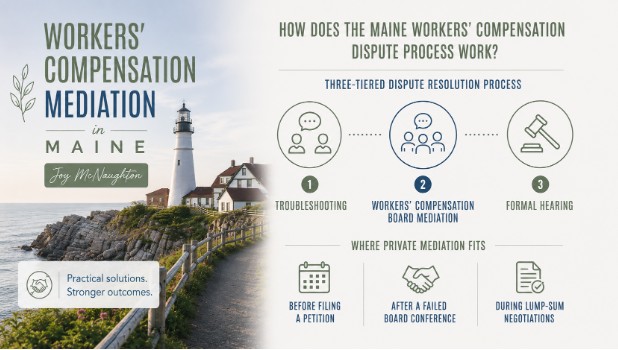
Title 39-A of the Maine Revised Statutes, the Maine Workers’ Compensation Act, establishes a three-tiered dispute resolution process: troubleshooting, Workers’ Compensation Board mediation, and formal hearing.
Private workers’ compensation mediation fits alongside that process at three distinct stages — before filing a petition, after a failed board conference, and during lump-sum negotiations.
How Workers' Compensation Board Mediation Works
Under Title 39-A §313, Workers’ Compensation Board mediation is the mandatory second tier of the dispute resolution process — parties who cannot resolve a dispute through troubleshooting must attend a mediation conference before the board schedules a formal hearing:
- A board mediator gives each party an opportunity to explain claims or defenses, reviews supporting documents, and works with the parties to find common ground through joint sessions and separate caucuses
- If the parties reach an agreement, the mediator completes a Record of Mediation — a binding written document signed by all parties.
- If no agreement is reached, the mediator certifies the impasse, and the claim proceeds to a formal hearing before an Administrative Law Judge.
Where Private Mediation Fits the Three-Tier Process
Private workers’ compensation mediation fits the Maine process at three distinct points — so parties can resolve disputes faster than the board hearing queue allows:
1
Before filing a petition
Parties engage a private mediator to resolve a dispute before it enters the formal Workers’ Compensation Board system entirely, avoiding troubleshooting and board mediation delays.
2
After a failed board conference
Parties use private mediation as a further settlement opportunity after the mandatory board mediation conference fails to produce an agreement, before entering the formal hearing queue.
3
During lump-sum negotiations
Parties use private mediation to structure lump-sum settlement terms under Title 39-A §352 before submitting the agreement for board approval.
Why Does Workers' Compensation Hearing Experience Matter in Mediation?
A workers’ compensation mediator with formal hearing experience can evaluate how a disputed claim is likely to fare before an Administrative Law Judge — giving both sides a realistic basis for settlement negotiation. McNaughton completed more than 500 workers’ compensation testimonial hearings in all five regional offices– Portland, Lewiston, Augusta, Bangor, and Caribou–dealing with claims arising out of all 16 of Maine’s counties.
What 500+ Hearings Mean at the Mediation Table
A mediator without formal hearing experience cannot tell parties what a hearing actually costs, how long the process takes, or how an Administrative Law Judge weighs competing medical opinions on incapacity. A mediator who has completed more than 500 testimonial hearings across the full geographic range of Maine workers’ compensation proceedings can provide that evaluation — and that direct hearing-room knowledge translates into practical mediation value:
- Injured workers and their attorneys receive an honest assessment of how their claim is likely to fare at a formal hearing, including medical evidence standards and incapacity assessment criteria.
- Insurers receive a mediator who understands reserve calculations, coverage defenses, and the settlement authority framework that governs claim resolution on the carrier side.
- Both sides receive a neutral who has sat in the same hearing room they are trying to avoid — and understands exactly what it costs to go there.
Dual-Side Representation as a Differentiator
McNaughton represented clients at Preti Flaherty, Berman and Simmons, and Hanover Insurance across personal injury and workers’ compensation matters — appearing for injured personal injury claimants, employers, and Hanover Insurance across a 34-year career. A mediator who has represented only one side enters the room with an incomplete picture of how the other side calculates its position.
Dual-side representation means the mediator understands both the internal reasoning behind an insurer’s denial and the financial pressure an injured worker faces when benefits are delayed — and can bridge gaps that a mediator without insurer-side and employee-side experience cannot identify.
Workers’ compensation disputes that reach formal hearing cost all parties months and thousands in legal fees. McNaughton’s 500+ hearings give both sides a faster resolution. Call (207) 712-8995 or schedule a session.
Who Benefits from Workers' Compensation Mediation — Employers or Employees?
Both sides of a Maine workers’ compensation dispute benefit from private mediation — injured workers gain faster resolution and payment certainty, while employers and insurers close claims and eliminate open reserve exposure.
The Injured Worker's Perspective
An injured worker who cannot return to the same job faces immediate financial pressure. Workers’ compensation benefits under Title 39-A §212 replace 2/3 of the worker’s average weekly wage for total incapacity, subject to the maximum benefit level set annually by the Maine Department of Labor.
Disputed claims delay those payments. Private mediation resolves disputes faster than a formal hearing — which routinely takes four to six months to schedule and two to four additional months for the Administrative Law Judge’s written decision — so the injured worker gains certainty sooner.
Injured workers benefit from private mediation because:
- The outcome is controlled by the parties, not assigned by a judge unfamiliar with the worker's specific circumstances
- Lump-sum agreements under §352 can be structured to address medical cost projections and future wage loss in ways a formal Administrative Law Judge decision cannot.
- Sessions are mostly confidential — nothing said in mediation is admissible at a formal hearing.
The Employer and Insurer Perspective
Employers carry higher experience modification rates when claims remain open and contested. Insurers hold open reserves against unresolved claims until the matter is formally closed.
A negotiated resolution closes the claim, fixes the financial exposure, and eliminates the cost and disruption of full hearing preparation.
Employers and insurers benefit from private mediation because:
- Hearing preparation — independent medical examinations, witness depositions, and attorney fees for a full evidentiary proceeding — adds substantial cost before a single hour of testimony
- An Administrative Law Judge's written decision can take two to four months after the hearing itself, extending total claim exposure beyond the hearing date.
- A mediator with direct insurer-side experience understands reserve structures and Maine Administrative Law Judge analysis, producing settlements that hold without requiring further proceedings.
How Much Does Workers' Compensation Mediation Cost in Maine?
Private workers’ compensation mediation is billed at an hourly rate, and most sessions resolve in two to three hours, so parties reach resolution in a single session rather than waiting months for a formal hearing.
Complex claims involving permanent impairment ratings, multiple parties, or contested medical opinions may require additional session time. Contact the office at (207) 712-8995 for current rates.
| Private Mediation | Formal Hearing | |
|---|---|---|
| Timeline | Resolves in a single session of two to three hours | Four to six months to schedule; two to four additional months for written decision |
| Preparation | Mediation statements submitted in advance | Independent medical examinations, depositions, and witness preparation |
| Cost structure | Hourly rate, typically shared by parties | Attorney fees, expert fees, and deposition costs for both sides |
| Outcome control | Parties negotiate and control the agreement | Administrative Law Judge issues a binding written decision |
| Confidentiality | Mostly confidential — no statements admissible at hearing | Formal record of proceedings |
Review McNaughton’s full mediation background before scheduling.
The practice also provides family mediation, divorce mediation, gray divorce mediation, and elder mediation for Maine families.
Frequently Asked Questions
What is workers' compensation mediation in Maine?
A neutral mediator facilitates voluntary, confidential negotiations between an injured worker, employer, and insurer to reach a resolution of a disputed workers' compensation claim. The mediator does not decide the outcome — the parties control the final agreement through direct negotiation.
How does private workers' compensation mediation differ from Workers' Compensation Board mediation?
Workers' Compensation Board mediation under Title 39-A §313 becomes mandatory after troubleshooting fails, and board-employed mediators conduct the conferences at five regional offices. Private mediation allows parties to arrange sessions with an independent mediator before, during, or after the board process at any stage.
When should parties use private workers' compensation mediation?
Parties benefit from private mediation when a Workers' Compensation Board conference fails to produce an agreement, when they want to negotiate lump-sum settlement terms under Title 39-A §352, or when both sides want a mediator with direct experience in Maine workers' compensation hearings.
What workers' compensation hearing experience does the mediator bring?
The mediator completed more than 500 workers' compensation testimonial hearings , representing Hanover insurance and its insureds. McNaughton also represented many injured plaintiffs in Superior Court. That courtroom and hearing-room background gives all parties a neutral who understands how an Administrative Law Judge evaluates disputed claims.
Is workers' compensation mediation confidential in Maine?
Private workers' compensation mediation is mostly confidential under Maine law. No statements or positions taken during mediation are admissible at any subsequent formal hearing. Under Title 39-A §313, no aspect of a Workers' Compensation Board conference other than the Record of Mediation is discoverable.
What types of workers' compensation disputes can private mediation resolve?
Private mediation resolves benefit denial disputes, total and partial incapacity disagreements, medical treatment authorization conflicts, return-to-work disputes under Title 39-A §214, and lump-sum settlement negotiations under §352 — covering the full range of contested issues in a Maine workers' compensation claim.
How long does a workers' compensation mediation session take?
Most workers' compensation mediation sessions run two to three hours. Complex claims involving permanent impairment ratings, multiple parties, or significant medical disputes may require additional session time. Sessions are available in-person in Wiscasset, Maine, or by Zoom throughout Maine and southern New Hampshire.
How do parties schedule a private workers' compensation mediation?
Parties or their attorneys can call (207) 712-8995 or email joycraftsmcnaughton@gmail.com to discuss the dispute and schedule a session. An initial conversation covers the nature of the claim, the parties involved, and whether an in-person or Zoom format best fits the circumstances.
Workers’ compensation disputes drain injured workers and lock employers into open exposure. McNaughton’s 500+ Maine workers’ compensation hearings give both sides a faster resolution. Call (207) 712-8995 to schedule a session.
JM
Joy Crafts McNaughton, J.D.
Licensed Maine attorney and rostered Maine CADRES family mediator. Provides private personal injury mediation throughout Maine and southern New Hampshire. Contact: (207) 712-8995