Divorce Mediation in New Hampshire | Joy Crafts McNaughton, J.D.
In This Article
Divorce Mediation
Updated July 2026
By Joy Crafts McNaughton, J.D.
Joy Crafts McNaughton, J.D., a licensed Maine attorney and rostered Maine CADRES family mediator, provides private divorce mediation for couples throughout New Hampshire via Zoom.
Whether you face a court-ordered requirement under NH RSA 461-A:7 or choose mediation before filing, McNaughton brings 34 years of litigation experience and 137+ hours of mediation training to help you reach a voluntary agreement on custody, parenting time, property division, and support.
Key Takeaways
NH RSA 461-A:7 requires court-ordered mediation in every divorce involving minor children — only domestic violence findings, child abuse allegations, or undue hardship qualify as exceptions.
Private mediators satisfy the court mandate under Rule 2.13(F) as long as they hold RSA 328-C certification — no Judicial Branch contract required.
The mediator produces a Memorandum of Understanding; one or both attorneys then draft the formal Settlement Agreement that the court adopts into the judgment.
Private mediation typically costs $1,500–$5,000 total across 2–4 sessions, compared to $10,000–$30,000+ for contested litigation in New Hampshire.
A New Hampshire divorce does not have to mean a courtroom battle. Call Joy McNaughton, J.D., at (207) 712-8995 to schedule a mediation consultation.
What Does Divorce Mediation Cover in New Hampshire?
Divorce mediation is a structured process in which a trained neutral helps separating spouses negotiate divorce terms outside of court. RSA 461-A:7 codifies mediation as New Hampshire’s preferred resolution path before litigation.
NH divorce mediation addresses every issue a judge would otherwise decide at trial:
- Parenting schedules and decision-making responsibility
- Child support calculations and modifications
- Equitable division of marital property, real estate, and personal assets
- Retirement account and pension allocation
- Alimony type, duration, and amount
- Marital debt assignment
- Future obligations, including college expenses
RSA 461-A:7 prohibits the mediator from imposing a decision on either party. Any agreement is entirely voluntary, and a failure to settle preserves every right to litigate unresolved disputes before the court.
All communications during mediation — oral and written — are mostly confidential under RSA 461-A:7, VII. Statements made by either party, the mediator, or any other person present are privileged and cannot be admitted as evidence in court, with narrow exceptions under RSA 328-C:9.
When the parties reach an agreement, the mediator prepares a Memorandum of Understanding documenting the agreed terms. Both spouses sign the MOU.
One or both of the parties’ attorneys then drafts a comprehensive Settlement Agreement — the formal legal document the court reviews and adopts into the final divorce judgment. The court will not accept the MOU itself as a proposed judgment as of July 2026.
Is Divorce Mediation Mandatory in New Hampshire?
New Hampshire requires court-ordered mediation in every divorce, legal separation, or parenting petition involving minor children. RSA 461-A:7 and Circuit Court Family Division Rule 2.13 direct the court to order participation unless a statutory exception applies.
Six exceptions allow the court to waive the mandate:
- Undue hardship to a party
- An existing agreement to use an alternate dispute resolution procedure
- An allegation of abuse or neglect of a minor child
- A finding of alcoholism or drug abuse (unless both parties consent)
- An allegation of serious psychological or emotional abuse
- Lack of an available suitable mediator within a reasonable time
Absolute bar: RSA 461-A:7, V prohibits court-ordered mediation when a finding of domestic violence exists under RSA 173-B:1, unless both parties agree.
Divorces without minor children follow a different statute. RSA 458:15-c gives the court discretion to order mediation on the request of either party or on its own initiative. When ordered, all relevant issues, including property settlement and alimony, are mediated unless the court directs otherwise.
What Happens During the Divorce Mediation Process in New Hampshire?
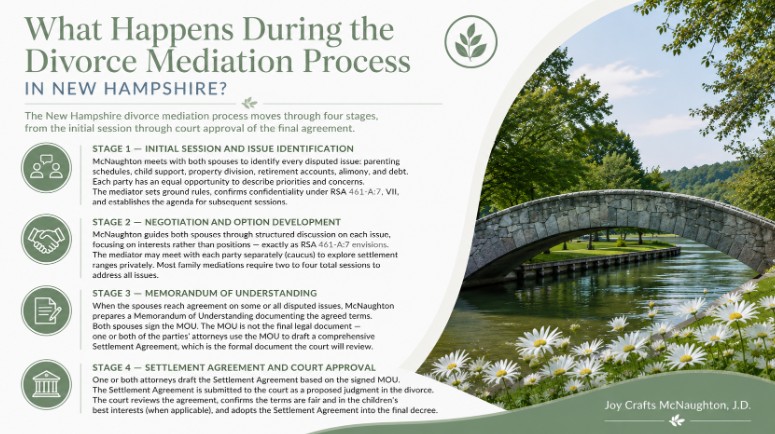
The New Hampshire divorce mediation process moves through four stages, from the initial session through court approval of the final agreement.
1
Stage 1 — Initial Session and Issue Identification
The New Hampshire divorce mediation process moves through four stages, from the initial session through court approval of the final agreement.
2
Stage 2 — Negotiation and Option Development
McNaughton guides both spouses through structured discussion on each issue, focusing on interests rather than positions — exactly as RSA 461-A:7 envisions.
The mediator may meet with each party separately (caucus) to explore settlement ranges privately. Most family mediations require two to four total sessions to address all issues.
3
Stage 3 — Memorandum of Understanding
When the spouses reach agreement on some or all disputed issues, McNaughton prepares a Memorandum of Understanding documenting the agreed terms. Both spouses sign the MOU. The MOU is not the final legal document — one or both of the parties’ attorneys use the MOU to draft a comprehensive Settlement Agreement, which is the formal document the court will review.
4
Stage 4 — Settlement Agreement and Court Approval
One or both attorneys draft the Settlement Agreement based on the signed MOU. The Settlement Agreement is submitted to the court as a proposed judgment in the divorce.
The court reviews the agreement, confirms the terms are fair and in the children’s best interests (when applicable), and adopts the Settlement Agreement into the final decree.
New Hampshire courts will not accept the MOU itself as a proposed judgment as of July 2026.
Struggling to agree on custody or asset division in your New Hampshire divorce? Joy McNaughton, J.D., helps couples build workable agreements through private mediation.
Should You Choose a Private Mediator or a Court-Appointed Mediator in NH?
Circuit Court Family Division Rule 2.13(F) allows parties to arrange private mediation with any mediator of their choice, regardless of whether that mediator holds a Judicial Branch contract.
Choosing private mediation does not exempt a couple from the mandatory mediation requirement — the court accepts private mediation in satisfaction of RSA 461-A:7 as long as the mediator holds RSA 328-C certification.
| Factor | Court-Contracted Mediator | Private Mediator |
|---|---|---|
| Selection | Assigned by the court | Chosen by both spouses |
| Scheduling | Court-controlled, subject to system availability | Parties set the calendar directly |
| Session Format | Two-hour blocks at the courthouse or video | Flexible length — office, neutral site, or Zoom |
| Cost Structure | First 4 hours covered by filing fee; sliding scale after | Hourly rate set by mediator; parties split cost |
| Typical Total Cost | Sliding scale under Supreme Court Rule 48-B | $1,500–$5,000 for most divorces (2–4 sessions) |
| Certification | RSA 328-C certified + Judicial Branch contract | RSA 328-C certified (contract not required) |
| Satisfies RSA 461-A:7 | Yes | Yes |
Key differences in practice:
Court-contracted mediators are assigned — parties have no input on selection or scheduling
Private mediation can begin before filing, immediately after filing, or at any point during the case
Private mediators with trial experience give both spouses a realistic framework for evaluating how a New Hampshire judge would likely rule on contested points
Flexible session length allows the mediator to structure time around complex issues — retirement division, business valuation, or contested parenting plans — rather than compressing everything into two-hour blocks
Why Choose Joy Crafts McNaughton, J.D., for NH Divorce Mediation?
McNaughton has been a licensed Maine attorney since 1985, admitted to the Bar after clerking for the Maine Supreme Judicial Court from 1984 to 1985. Her litigation career spans 1985 through 2016 and includes work at Preti Flaherty, Berman and Simmons, and Hanover Insurance.
McNaughton was admitted to the New Hampshire Bar in 2010 and remained active there representing Hanover Insurance and its insureds until 2016. She is currently licensed with the New Hampshire bar, but on inactive status.
Trial and hearing experience:
- 14 jury trials tried to conclusion in the Maine Superior Court and federal courts 1 in NH Superior Court.
- 500+ contested workers' compensation hearings across all 16 Maine counties
- Extensive personal injury and insurance defense litigation
Mediation credentials:
| Year | Training | Provider | Hours |
|---|---|---|---|
| 2013 | Basic Mediation Training | University of Southern Maine | 40 |
| 2020 | Advanced Family Mediation | Volunteers of America Northern New England | 14 |
| 2021 | Elder Mediation Training | Elder Decisions | 21 |
| 2021 | Divorce Financial Planning for Mediators | Mosten Guthrie | 6 |
| 2021 | Mediating Complex Family Disputes | Mosten Guthrie | 6 |
| 2022 | Advanced Elder Mediation | CADRES | 21 |
| 2022 | Trauma-Informed Mediation | Mosten Guthrie | 6 |
| 2022 | Mediating Retirement Assets | Mosten Guthrie | 6 |
| 2023 | Advanced Divorce Mediation | Mosten Guthrie | 12 |
| 2024 | Advanced Personal Injury Mediation | MCLE | 12 |
| Total | 137+ |
McNaughton has been a rostered Maine CADRES family mediator since fall 2020 and has conducted more than 200 court-connected family mediations between 2021 and 2024, with private mediations adding to that total.
How McNaughton serves New Hampshire clients:
- Remote Zoom sessions available statewide with the same confidentiality protections as in-person mediation
- In-person sessions at 24 Foye Road, Wiscasset, Maine — accessible to Portsmouth, Dover, Rochester, and seacoast NH families
- Full-scope divorce mediation covering parenting plans, child support, property division, retirement allocation, alimony, and debt assignment
- Gray divorce mediation for later-in-life couples navigating Social Security timing, pension division, and downsizing
- Pre-suit mediation producing a Memorandum of Understanding before either party files — so your attorneys can draft the Settlement Agreement and you can file uncontested
McNaughton does not advocate for either party, does not provide legal advice, and encourages both spouses to retain independent counsel for converting the MOU into the formal Settlement Agreement the court requires.
| Factor | Private Mediation | Contested Litigation |
|---|---|---|
| Privacy | Mostly confidential — no public record | Public court proceedings and records |
| Schedule | Parties choose date, time, and format | Court-assigned dates, often months away |
| Cost | $1,500–$5,000 typical total | $10,000–$30,000+ in attorney fees |
| Timeline | 2–4 sessions in most cases | 12–18 months average in NH |
| Control | Parties build their own agreement | The judge decides for both parties |
How Much Does Divorce Mediation Cost in New Hampshire?
Private divorce mediation in New Hampshire typically costs $1,500 to $5,000 total, with most cases resolving in two to four sessions.
McNaughton charges an hourly rate for private mediation, and both spouses split the fee — so each party pays a fraction of what a single attorney would charge for contested litigation.
| Cost Factor | Court-Referred Mediation | Private Mediation | Contested Litigation |
|---|---|---|---|
| First 4 Hours | Covered by a filing fee | Hourly rate applies from session one | N/A — attorney retainer required |
| Additional Hours | Income-based sliding scale under Supreme Court Rule 48-B | Hourly rate; parties split the cost | $250–$400+/hour per attorney |
| Typical Total | Sliding scale varies | $1,500–$5,000 | $10,000–$30,000+ |
| Indigent Parties | Paid from the state mediation fund under RSA 490-E:4 | Not applicable | Legal aid if eligible |
| Timeline | Court schedules — weeks to months | 2–4 sessions on your calendar | 12–18 months average in NH |
Court-referred mediation covers the first four hours through the filing fee. Fees beyond four hours follow an income-based sliding scale set by Supreme Court Rule 48-B. When both parties are indigent, RSA 490-E:4 directs payment from the state’s mediation and arbitration fund.
Private mediation eliminates the court scheduling bottleneck — so you can resolve custody, support, and property disputes in weeks rather than waiting months for a court-assigned mediator’s availability.
The total cost of private mediation represents a fraction of what New Hampshire couples typically spend on contested divorce litigation, where attorney fees alone average $10,000 to $30,000 or more.
Frequently Asked Questions
Is divorce mediation mandatory in New Hampshire?
Divorce mediation is mandatory in New Hampshire when minor children are involved under RSA 461-A:7. The court must order participation unless statutory exceptions apply, including domestic violence findings, child abuse allegations, or undue hardship. Divorces without children follow RSA 458:15-c, where mediation is discretionary.
What issues can divorce mediation resolve in NH?
Divorce mediation in New Hampshire addresses parenting schedules, decision-making responsibility, child support, division of marital property, debt allocation, alimony, and future obligations such as college expenses. The mediator covers every issue a judge would otherwise decide at trial.
Are mediation communications confidential in New Hampshire?
Mediation communications in New Hampshire are mostly confidential under RSA 461-A:7, VII. All oral and written statements made during the process are privileged and inadmissible in court, with narrow exceptions under RSA 328-C:9 covering mediator misconduct and threats of harm.
Can I choose my own mediator instead of using a court-assigned one?
New Hampshire permits parties to choose a private mediator under Circuit Court Family Division Rule 2.13(F). The mediator must hold RSA 328-C certification but does not need a Judicial Branch contract. Private mediation satisfies the court's mandatory mediation requirement.
What happens if we cannot reach an agreement in mediation?
Parties who do not reach agreement in mediation lose no rights under RSA 461-A:7. The mediator reports to the court that the process was unproductive, and the case returns to litigation. Partial agreements on some issues are filed with the court separately.
How much does divorce mediation cost in New Hampshire?
Private divorce mediation in New Hampshire typically costs $1,500 to $5,000 total across two to four sessions. Court-referred mediation covers the first four hours through filing fees, with additional hours billed on a sliding scale under Supreme Court Rule 48-B.
Can mediation happen before filing for divorce?
Pre-suit mediation allows couples to resolve custody, support, property, and other disputes before filing in New Hampshire. McNaughton prepares a Memorandum of Understanding, which the parties' attorneys then convert into a formal Settlement Agreement for submission to the court.
What is the difference between an MOU and a Settlement Agreement?
The Memorandum of Understanding documents the terms both parties agreed to during mediation. One or both attorneys then draft a comprehensive Settlement Agreement — the formal legal document submitted to the court. New Hampshire courts adopt the Settlement Agreement into the judgment, not the MOU.
Your children deserve parents who resolved their divorce without a trial. Contact Joy McNaughton, J.D., at (207) 712-8995 to start private mediation today.
JM
Joy Crafts McNaughton, J.D.
Licensed Maine attorney and rostered Maine CADRES family mediator. Provides private personal injury mediation throughout Maine and southern New Hampshire. Contact: (207) 712-8995