The Maine Agricultural Mediation Program is a federally funded, no-cost mediation service for Maine farmers, fishermen, and agricultural businesses facing disputes over USDA loans, conservation programs, wetland determinations, family farm transitions, and neighbor conflicts.
Joy Crafts McNaughton, J.D., a licensed Maine attorney rostered on the MAMP panel, completed the program’s 16-hour agricultural mediation training in both 2017 and 2025 — making her one of the few Maine mediators with active, current MAMP credentials.
Key Takeaways:
- MAMP is part of the USDA Agricultural Mediation Program, locally managed by the University of Maine Cooperative Extension, and provides mediation at no cost to participants.
- The program covers USDA loan disputes, FSA adverse decisions, conservation compliance, wetland determinations, pesticide issues, family farm transitions, lease conflicts, and farmer-neighbor disagreements.
- MAMP co-mediator eligibility requires both a 40-hour basic mediation course and MAMP’s own 16-hour agricultural mediation training — McNaughton holds both, plus 137+ total hours across all mediation disciplines.
- Mediation through MAMP is voluntary, confidential, and guided by trained neutrals who do not take sides or impose outcomes.
Facing a USDA loan dispute, a family farm transition conflict, or an FSA adverse decision? Call Joy McNaughton at (207) 712-8995 to discuss agricultural mediation.
What Is the Maine Agricultural Mediation Program?
The Maine Agricultural Mediation Program is a USDA-certified mediation service operated by the University of Maine Cooperative Extension under the authority of the Agricultural Credit Act of 1987 and the Food, Agriculture, Conservation, and Trade Act of 1990. MAMP provides no-cost, confidential mediation and conflict resolution services to Maine’s agricultural community — including land and sea farmers, producers, loan holders, and agricultural service providers.
The USDA Farm Service Agency certifies state agricultural mediation programs nationwide. Maine’s program is one of approximately 40 certified programs across the country. MAMP is locally managed from the University of Maine’s campus in Orono and serves all 16 Maine counties.
Beyond mediation, MAMP offers contract and lease co-drafting assistance and personal financial coaching for agricultural operations. All MAMP services are funded through the USDA, which means farmers and fishermen pay nothing to participate.
Who Qualifies for MAMP Mediation?
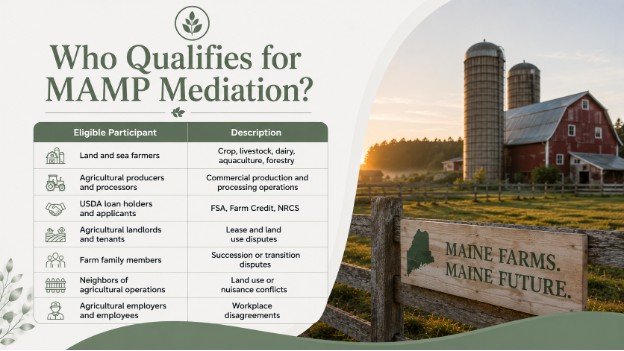
MAMP mediation is available to any member of Maine’s agricultural community involved in a qualifying dispute. The program defines its service population broadly — eligibility is not limited to full-time commercial farmers.
| Eligible Participant | Description |
| Land and sea farmers | Crop, livestock, dairy, aquaculture, forestry |
| Agricultural producers and processors | Commercial production and processing operations |
| USDA loan holders and applicants | FSA, Farm Credit, NRCS |
| Agricultural landlords and tenants | Lease and land use disputes |
| Farm family members | Succession or transition disputes |
| Neighbors of agricultural operations | Land use or nuisance conflicts |
| Agricultural employers and employees | Workplace disagreements |
A participant does not need to retain an attorney to request MAMP mediation. The program provides trained co-mediators who guide the process — so farmers can focus on resolving the dispute rather than navigating legal procedure.
What Disputes Does MAMP Cover?
MAMP covers a wide range of agricultural disputes, from adverse decisions by federal agencies to private conflicts between neighbors and family members.
USDA and federal agency disputes:
- FSA loan denials, restructuring, and foreclosure actions
- NRCS conservation program compliance disputes
- Wetland determinations and appeals
- Pesticide application disputes
- USDA program eligibility decisions
Private agricultural disputes:
- Family farm transition and succession planning — deciding who inherits the operation, how to divide land, and how to compensate non-farming siblings
- Agricultural lease conflicts — terms, renewals, rent disputes, and land use restrictions
- Farmer-neighbor disputes — boundary issues, drainage, noise, odor, and environmental impact
- Worker-employer disagreements on agricultural operations
Family farm transitions are among the most common MAMP cases. Maine’s agricultural operations are overwhelmingly family-owned, and transferring a farm to the next generation involves overlapping financial, emotional, and legal issues that no single professional — attorney, accountant, or family therapist — can resolve alone.
MAMP mediation brings all stakeholders to the table under the guidance of trained neutrals — so the family can reach agreement rather than lose the farm to unresolved conflict.
Farm transitions, USDA loan disputes, and conservation compliance conflicts deserve a mediator who knows Maine agriculture. Call Joy McNaughton at (207) 712-8995 for information and contact with MAMP.
What Are Joy McNaughton’s MAMP Credentials?
McNaughton completed MAMP’s 16-hour agricultural mediation training twice — in 2017 and again in 2025 — maintaining active, current roster eligibility with the program.
The 2025 training, facilitated by University of Maine Cooperative Extension staff and MAMP leadership, covered conflict theory, stress response, participant rapport, interventions, ethics, and case studies drawn from Maine’s agricultural community.
Guest presenters from the USDA, FSA, Land for Good, MOFGA, and Maine Farmland Trust provided subject-matter depth on the federal and state programs that generate the disputes MAMP mediators handle.
MAMP co-mediator eligibility requires completion of both the 16-hour agricultural mediation training and a 40-hour basic mediation course.
McNaughton’s 40-hour basic mediation training at the University of Southern Maine in 2013 satisfies that requirement. Her total mediation training across all disciplines — family, divorce, elder, personal injury, trauma-informed, and agricultural — exceeds 137 hours.
Her 34 years of active practice, 15 jury trials, and 500+ contested workers’ compensation hearings across all 16 Maine counties give her firsthand experience with the financial pressures, insurance disputes, and regulatory compliance issues that agricultural operations face — so she can help parties evaluate realistic outcomes rather than negotiate in the abstract.
How Do You Request MAMP Mediation?
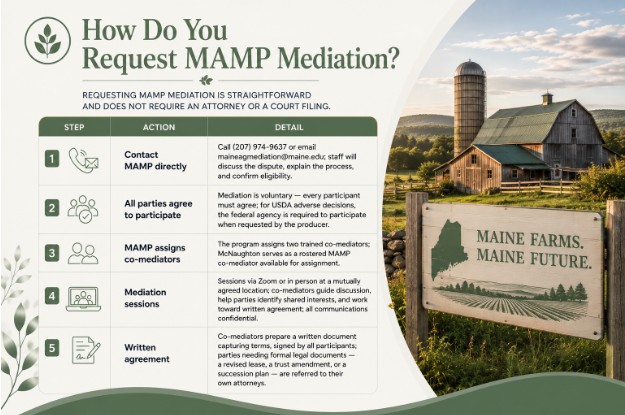
Requesting MAMP mediation is straightforward and does not require an attorney or a court filing.
| Step | Action | Detail |
| 1 | Contact MAMP directly | Call (207) 974-9637 or email maineagmediation@maine.edu; staff will discuss the dispute, explain the process, and confirm eligibility |
| 2 | All parties agree to participate | Mediation is voluntary — every participant must agree; for USDA adverse decisions, the federal agency is required to participate when requested by the producer |
| 3 | MAMP assigns co-mediators | The program assigns two trained co-mediators; McNaughton serves as a rostered MAMP co-mediator available for assignment |
| 4 | Mediation sessions | Sessions via Zoom or in person at a mutually agreed location; co-mediators guide discussion, help parties identify shared interests, and work toward a written agreement; all communications are confidential |
| 5 | Written agreement | Co-mediators prepare a written document capturing terms, signed by all participants; parties needing formal legal documents — a revised lease, a trust amendment, or a succession plan — are referred to their own attorneys |
Frequently Asked Questions
What is the Maine Agricultural Mediation Program?
The Maine Agricultural Mediation Program is a USDA-certified, no-cost mediation service operated by the University of Maine Cooperative Extension. MAMP provides confidential mediation for disputes involving USDA loans, conservation programs, family farm transitions, lease conflicts, and farmer-neighbor disagreements across all 16 Maine counties.
Does MAMP mediation cost anything?
MAMP mediation is provided at no cost to participants. The program is funded through the USDA Agricultural Mediation Program. Farmers, fishermen, and agricultural businesses pay nothing for mediation sessions, co-mediator services, or the preparation of a written agreement through the program.
Can MAMP mediators make decisions about my dispute?
MAMP co-mediators cannot make decisions, impose settlements, or take sides in any dispute. The mediators guide the conversation and help participants identify shared interests. Any agreement reached during MAMP mediation is entirely voluntary and must be accepted by all participating parties.
What training do MAMP co-mediators need?
MAMP co-mediator eligibility requires completion of the program’s 16-hour agricultural mediation training and a 40-hour basic mediation course or equivalent. The 16-hour training covers conflict theory, agricultural case studies, ethics, and presentations from USDA, FSA, and Maine agricultural service providers.
Can I use MAMP for a family farm transition dispute?
MAMP mediation covers family farm transition and succession planning disputes, including decisions about who inherits the operation, how to divide land and assets, and how to compensate non-farming family members. Farm transition cases are among the most common disputes MAMP mediators handle in Maine.
Does the USDA have to participate in MAMP mediation?
Federal agencies including the Farm Service Agency, are required to participate in certified state agricultural mediation programs when a producer requests mediation of an adverse decision. MAMP is certified by the USDA under the Food, Agriculture, Conservation, and Trade Act of 1990, which establishes this participation requirement.
Is MAMP mediation confidential?
MAMP mediation is confidential. All oral and written communications made during the process are privileged and cannot be disclosed or used in subsequent legal proceedings. The confidentiality protection gives both parties the freedom to discuss realistic settlement options without risk.
How do I contact the Maine Agricultural Mediation Program?
The Maine Agricultural Mediation Program can be reached by calling (207) 974-9637 or emailing maineagmediation@maine.edu. MAMP is managed by the University of Maine Cooperative Extension from its Orono campus and serves agricultural operations in every Maine county.