Personal injury mediation resolves disputed Maine injury claims — automobile accidents, premises liability, medical malpractice, and insurance coverage disputes — without the cost and uncertainty of trial.
Joy Crafts McNaughton, J.D., a licensed Maine attorney with 34 years of personal injury litigation experience on both the plaintiff and insurer sides, provides private mediation for attorneys and claimants throughout Maine.
Key Takeaways
- Maine Rule of Civil Procedure 16B requires alternative dispute resolution — including mediation — in Superior Court personal injury cases with claimed damages of $30,000 or more.
- Private mediation can resolve personal injury claims before filing a lawsuit, during litigation, or after a court-ordered mediation conference fails to produce an agreement.
- A mediator with litigation experience on both the plaintiff and insurer sides evaluates how an injury claim is likely to resolve at trial, giving both parties a realistic basis for settlement.
- Personal injury mediation sessions in Maine typically last half a day or a full day and cost a fraction of what trial preparation and testimony require.
Trial preparation drains months and thousands in expert fees from both sides of a personal injury dispute. McNaughton’s dual-side litigation experience gives attorneys and claimants a faster path to resolution. Call (207) 712-8995.
What Is Personal Injury Mediation in Maine?
Personal injury mediation is a voluntary, confidential process in which a neutral mediator helps an injured claimant and the opposing party — typically an insurer or defendant’s counsel — negotiate a resolution of a disputed injury claim.
The mediator does not decide the case or impose a settlement. The mediator facilitates structured negotiation, helps each side evaluate the strengths and weaknesses of its position, and assists the parties in reaching a written settlement agreement on their own terms.
Maine Rule of Civil Procedure 16B requires parties in Superior Court civil cases — including personal injury cases with claimed damages of $30,000 or more — to participate in alternative dispute resolution before trial.
If the parties cannot agree on which form of alternative dispute resolution to use, mediation is the default process under Rule 16B. The court’s scheduling order sets a deadline for completing alternative dispute resolution, typically 60 to 120 days after the Rule 16(a) Scheduling Order.
Personal injury cases with claimed damages below $30,000 are exempt from the mandatory alternative dispute resolution requirement, though parties in those cases may still choose private mediation voluntarily.
When Should You Use Personal Injury Mediation — Before or After Filing a Lawsuit?
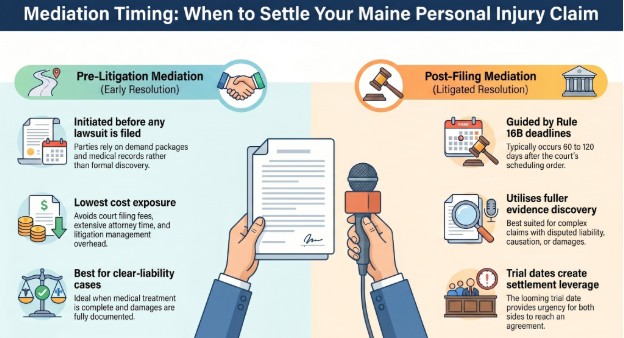
Attorneys and claimants in Maine can use personal injury mediation at three distinct stages — before filing a lawsuit, during pending litigation, or after a court-ordered mediation conference produces no agreement.
Each stage offers different advantages depending on the complexity of the claim and the parties’ readiness to negotiate.
| Pre-Litigation Mediation | Post-Filing Mediation | |
| Timing | Before any lawsuit is filed | After filing, typically within the Rule 16B deadline |
| Discovery completed | Minimal — parties rely on demand packages and medical records | Partial or full discovery completed |
| Cost exposure | Lowest — no court filing fees, limited attorney time | Higher filing fees, discovery, and motion practice already incurred |
| Best suited for | Clear-liability cases with documented damages | Complex claims with disputed liability, causation, or damages |
| Settlement leverage | Insurer avoids litigation defense costs; claimant avoids delay | Both sides have a fuller picture of the evidence; the trial date creates urgency |
Pre-litigation mediation works best when liability is clear, medical treatment is complete, and the claimant’s attorney has assembled a comprehensive demand package that includes medical records, billing summaries, lost-wage documentation, and a specific dollar demand.
Insurers benefit from pre-litigation mediation because resolving a claim before suit avoids the costs of retaining defense counsel, discovery costs, and the litigation management overhead that accompanies every filed case.
Post-filing mediation works best when the parties need discovery to evaluate disputed liability, causation, or the extent of damages.
In Maine Superior Court cases, the Rule 16B scheduling order sets a deadline for completing alternative dispute resolution — typically 60 to 120 days after the scheduling order — providing both sides with a structured timeline to reach a resolution before the case advances toward trial.
Why Does a Mediator’s Litigation Background Matter in Personal Injury Cases?
A personal injury mediator with trial experience can evaluate how a disputed claim is likely to resolve before a Maine jury — giving both the claimant and the insurer a realistic basis for settlement that a mediator without courtroom experience cannot provide.
McNaughton tried 15 jury cases to conclusion in Maine Superior Court and federal court, and represented clients on both sides of personal injury and insurance claims over 34 years of active practice in Maine.
What Plaintiff Attorneys and Claimants Gain
A mediator who has tried personal injury cases on the plaintiff side understands the claimant’s perspective from the inside — how juries evaluate pain and suffering testimony, how medical evidence is presented, and what trial preparation actually costs in time and expert fees:
- Claimants receive a mediator who understands the real-world value of their claim based on Maine jury verdict patterns, not just insurance company formulas
- Plaintiff attorneys receive a neutral who can explain to the opposing side why a demand figure is supported by the evidence, using the language and framework that trial lawyers rely on
- McNaughton’s work at Preti Flaherty and Berman and Simmons included plaintiff-side personal injury representation, giving her direct experience with claimant case preparation and trial strategy
What Defense Attorneys and Insurers Gain
A mediator who has represented insurers understands how carriers evaluate reserves, set settlement authority, and make coverage decisions — knowledge that allows the mediator to bridge the gap between an insurer’s opening offer and a claimant’s demand:
- Insurers receive a mediator who understands the internal process for adjusting settlement authority and can identify the specific information a claims adjuster needs to move the negotiation forward
- Defense attorneys receive a neutral who speaks the same language they use to evaluate risk and exposure — including comparative fault analysis, damages caps, and the cost of taking a case to verdict
- McNaughton’s work representing Hanover Insurance and its insureds in hundreds of mediations gives her direct knowledge of how insurers calculate claim value in Maine
Attorneys on both sides of a personal injury dispute and claimants navigating the process for the first time deserve a mediator who has been in the courtroom.
McNaughton’s 15 jury trials and 34 years of dual-side litigation experience inform every mediation session. Call (207) 712-8995 to schedule.
How Much Does Personal Injury Mediation Cost Compared to a Trial in Maine?
Personal injury mediation in Maine costs a fraction of what trial preparation and testimony require — and the fee is typically shared equally between the parties, so each side pays half the mediator’s rate per session.
| Cost Category | Private Mediation | Trial |
| Mediator or attorney fee structure | Hourly rate, shared equally between parties | Contingency fee (33% pre-trial, 40% at trial per standard Maine practice) or hourly defense billing at $282 per hour average for Maine civil litigation attorneys (Clio, 2026) |
| Expert witness fees | Not required for mediation | $5,000–$25,000+ per expert, depending on specialty and testimony time |
| Discovery and deposition costs | Not required — parties exchange documents voluntarily | Depositions, interrogatories, and document production add thousands in attorney time |
| Timeline | Half-day (3–4 hours) or full-day (6–8 hours) session | 12–24 months from filing to trial in the Maine Superior Court |
| Outcome control | Parties negotiate and control the settlement amount | Jury decides damages — outcome is uncertain |
The cost comparison is particularly relevant for claimants whose attorneys work on a contingency basis.
A settlement reached through mediation before trial preserves a larger share of the recovery for the claimant, because the contingency percentage remains at the pre-trial rate and the case avoids expert witness fees, deposition costs, and the additional attorney time that trial preparation demands.
What Should Attorneys and Claimants Bring to a Personal Injury Mediation Session?
The outcome of a personal injury mediation session depends heavily on preparation, and the preparation requirements differ for attorneys representing claimants, attorneys representing defendants or insurers, and unrepresented claimants.
For Plaintiff Attorneys
Plaintiff attorneys should prepare a mediation statement summarizing the facts, liability, damages, and settlement demand, along with supporting documentation:
- Complete medical records and billing summaries for all treatment related to the injury
- Lost wage documentation, including pay stubs, tax returns, and employer verification
- Expert reports, if available — including accident reconstruction, vocational rehabilitation, or life care planning
- A specific dollar demand supported by itemized special damages and a reasoned general damages figure
- Photographs, diagrams, or video evidence that support the liability and damages presentation
For Defense Attorneys and Insurers
Defense attorneys and insurers should prepare to respond to the claimant’s demand with a documented analysis:
- A written evaluation of liability exposure, including comparative fault analysis under Maine Title 14 §156
- Independent medical examination reports and any surveillance evidence
- Reserve information and settlement authority from the claims adjuster — the mediator cannot bridge a gap that the adjuster has not authorized
- A detailed breakdown of the basis for any counteroffer
For Unrepresented Claimants
Claimants who attend mediation without an attorney should bring all documentation that supports the value of the claim:
- Medical records and bills showing diagnosis, treatment, and prognosis
- Proof of lost income — pay stubs, employment records, or self-employment documentation
- Photographs of injuries and the accident scene
- Any correspondence with the insurance company, including denial letters or prior settlement offers
- A written list of questions and priorities for the mediation session
Frequently Asked Questions
Is personal injury mediation required in Maine?
Maine Rule of Civil Procedure 16B requires alternative dispute resolution in Superior Court personal injury cases with claimed damages of $30,000 or more. Cases below that threshold are exempt, though parties may still choose to pursue private mediation at any stage of a claim.
Can personal injury mediation happen before filing a lawsuit in Maine?
Private mediation can take place before any lawsuit is filed. Pre-litigation mediation works best when liability is clear, medical treatment is complete, and the claimant’s attorney has assembled a comprehensive demand package that includes medical records, billing summaries, and a specific dollar amount.
How long does a personal injury mediation session take in Maine?
Personal injury mediation sessions in Maine typically last half a day (three to four hours) or a full day (six to eight hours), depending on the complexity of the claim. Simple single-party cases often resolve in a half-day session, while multi-party or disputed-liability claims may require a full day.
Who pays for personal injury mediation in Maine?
The mediator’s fee is typically shared equally between the parties, with each side paying half the cost per session. The fee arrangement is negotiated directly between the parties and the mediator before the session — the court does not set the fee for private mediation.
What happens if personal injury mediation doesn’t produce a settlement?
The case continues through litigation as if mediation had not occurred. Nothing said, offered, or proposed during mediation is admissible in any subsequent court proceeding. The parties retain all their rights to bring the case to trial, and the mediator cannot be called as a witness.
Does the mediator provide legal advice during personal injury mediation?
The mediator operates as a pure neutral and does not provide legal advice to either party. The mediator may share observations about the strengths and weaknesses of each side’s position, but the mediator does not represent or advocate for either the claimant or the defendant.
Can insurance adjusters attend personal injury mediation in Maine?
Insurance adjusters regularly attend personal injury mediation sessions. The adjuster should have full settlement authority or direct access to a decision-maker who can authorize settlement during the session — mediation stalls when the adjuster lacks the authority to respond to movement at the table.
What is the difference between mediation and early neutral evaluation in Maine?
Mediation uses a neutral facilitator who helps the parties negotiate without offering an evaluation of the case. Early neutral evaluation uses a neutral with trial experience who provides a written assessment of likely trial outcomes. Both processes are available under Maine Rule of Civil Procedure 16B in Superior Court cases.
Should I hire a personal injury attorney before attending mediation?
Claimants benefit from having an attorney review the claim before attending mediation, because the mediator does not provide legal advice, and the insurer’s representative will have legal counsel. An attorney can prepare a demand package, evaluate the claim’s value, and advise on whether a proposed settlement is fair.
How do I schedule a personal injury mediation session in Maine?
Parties or their attorneys can call (207) 712-8995 or email joycraftsmcnaughton@gmail.com to discuss the case and schedule a session. An initial conversation covers the nature of the claim, the parties involved, and whether a half-day or full-day session is appropriate.